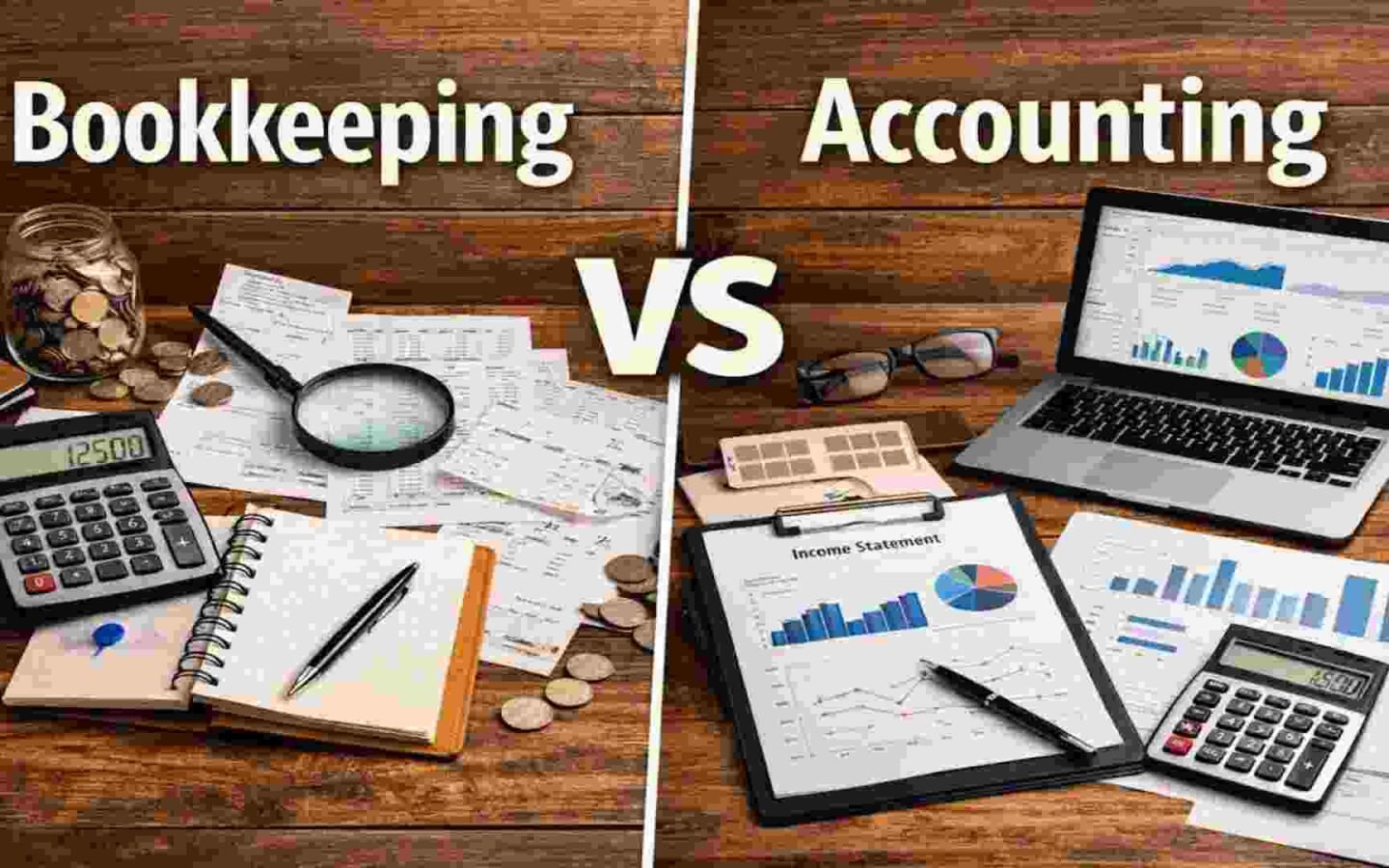
People use “bookkeeping” and “accounting” interchangeably all the time, and honestly, I used to as well until I actually ran a small business and realized how differently these two functions actually operate. The bookkeeping vs accounting distinction isn’t just semantic — it affects who you should hire and what you should expect from them.
Let’s clear up bookkeeping vs accounting properly, with examples that actually make sense for a small business owner, not just textbook definitions.
The Core Difference in One Line
Quick answer: Bookkeeping is the day-to-day recording of financial transactions, while accounting is the broader process of interpreting, analyzing, and reporting on those records to guide business decisions.
Related node: Basic Accounting Terms Every Small Business Owner Should Know · Marketing vs Advertising: What’s the Real Difference? · Business Registration Process in India: Step-by-Step Guide
Think of bookkeeping as data entry, and accounting as the analysis and strategy built on top of that data. One feeds the other.
What a Bookkeeper Actually Does
- Recording daily sales, purchases, and expenses
- Managing invoices and tracking payments received and due
- Reconciling bank statements against recorded transactions
- Maintaining organized, accurate financial records ready for review
- Processing payroll entries for employees
A bookkeeper’s job is largely transactional and repetitive — important, detail-heavy work, but generally not involving strategic financial decisions.
What an Accountant Actually Does
- Analyzing financial statements to identify trends and issues
- Preparing tax returns and ensuring regulatory compliance
- Advising on financial strategy, budgeting, and forecasting
- Conducting audits or financial reviews
- Interpreting the “why” behind the numbers a bookkeeper has recorded
Picture a bookkeeper recording that a small retail shop spent ₹40,000 more on inventory this month. An accountant is the one who looks at that number, compares it against sales trends, and advises whether that spending pattern is sustainable or a warning sign.
Related node: How to Get a Small Business Loan: Complete Guide 2026 · Zomato Business Case Study: Growth Strategy Explained
Qualifications Required
- Bookkeeping — doesn’t require formal certification in most cases, though training in accounting software (Tally, Zoho Books) is valuable
- Accounting — typically requires formal education; in India, a Chartered Accountant (CA) qualification represents the highest level of accounting expertise, though many accountants operate with commerce degrees and specialized training below CA level
This qualification gap is a big reason why bookkeeping services are generally more affordable than hiring a full accountant or CA.
When a Small Business Needs Just a Bookkeeper
If you’re a small business with straightforward transactions — a boutique, a small service business, a freelancer — a bookkeeper handling monthly record-keeping is often sufficient for daily operations, with an accountant brought in periodically (quarterly or at tax time) for the bigger picture.
When a Small Business Needs a Full Accountant
- Once you’re dealing with GST compliance, complex tax filings, or investor reporting
- When you need financial forecasting and strategic budget planning
- If you’re raising funding and need audited financial statements
- When your business structure becomes more complex (Pvt Ltd, multiple revenue streams) [link to related guide about business registration process here]
Can One Person Do Both Jobs?
Yes, particularly in small businesses, many accountants also handle bookkeeping tasks, especially early on when transaction volume is manageable. As a business grows, though, it usually makes financial sense to separate these roles — bookkeeping in-house or outsourced cheaply, accounting handled by a qualified professional for the higher-value strategic work.
Cost Differences
Bookkeeping services in India typically range from ₹3,000-₹15,000 per month depending on transaction volume and business size. Accounting and CA services, especially for tax filing, audits, and compliance, tend to cost significantly more — often ₹10,000-₹50,000+ depending on complexity, sometimes charged per service rather than monthly.
Common Misconception: “My Bookkeeper Handles My Taxes”
I’ve noticed this mistake fairly often — business owners assuming their bookkeeper is also managing tax compliance. In most cases, that’s not accurate. Bookkeepers maintain the records; a qualified accountant or CA typically needs to review those records and actually file taxes correctly, especially for anything beyond the simplest sole proprietorship. [link to related guide about basic accounting terms here]
FAQ
Is a bookkeeper cheaper than an accountant? Yes, generally significantly cheaper, since bookkeeping requires less specialized qualification than full accounting or CA services.
Can I do my own bookkeeping as a small business owner? Yes, especially in the early stages, using simple software like Tally or even a well-organized spreadsheet, though it takes discipline and consistency.
Do I need both a bookkeeper and an accountant? For small businesses, often not both separately — many CAs or accountants handle bookkeeping too. As you scale, separating the two roles usually makes sense.
What software is used for bookkeeping in India? Tally, Zoho Books, QuickBooks, and even Excel/Google Sheets for very small operations are commonly used.
How often should bookkeeping be done? Ideally weekly or at minimum monthly — letting records pile up for months makes reconciliation far more error-prone and time-consuming.
Is a CA required for GST filing, or can a bookkeeper do it? A bookkeeper can prepare the data, but GST filing typically requires proper accounting knowledge, and many businesses use a CA or qualified accountant for accuracy and compliance safety.
Conclusion
Understanding bookkeeping vs accounting helps you hire the right person for the right job instead of overpaying for services you don’t need yet, or underpaying for expertise you actually require. Start with solid bookkeeping habits from day one, and bring in proper accounting support as your business complexity grows — trying to skip either step tends to catch up with you eventually.