I still remember the blank look on a friend’s face when her accountant casually mentioned “accrued liabilities” during their first meeting. She nodded like she understood. She didn’t. Most small business owners feel this exact confusion, and honestly, nobody explains basic accounting terms for beginners in plain language often enough.
You don’t need a commerce degree to run a business. But you do need to understand enough accounting to avoid getting blindsided by your own numbers. Let’s go through the basic accounting terms for beginners that actually matter day to day.
Why Accounting Basics Matter Even If You Hire an Accountant
Quick answer: Even with an accountant handling your books, understanding basic accounting terms helps you make informed decisions, catch errors early, and avoid being financially dependent on someone else’s interpretation of your own business.
Related node: Difference Between Bookkeeping and Accounting Explained · Best Freelancing Websites to Find Clients in 2026 · 20 Low Investment Business Ideas for Beginners in India
Plenty of business owners hand everything to their CA and never look at the actual numbers themselves. That’s a mistake — you should understand your own financial statements, even if someone else prepares them.
Assets, Liabilities, and Equity
These three form the foundation of every balance sheet.
- Assets — everything your business owns that has value: cash, inventory, equipment, property
- Liabilities — everything your business owes: loans, unpaid supplier bills, credit card debt
- Equity — what’s left over for the owner after subtracting liabilities from assets; essentially your actual ownership stake
Picture a small boutique with ₹5 lakh in inventory and cash (assets), ₹1.5 lakh owed to suppliers (liabilities) — the owner’s equity is ₹3.5 lakh. That’s the real, honest value of what she owns in the business.
Related node: Leadership Skills Every Manager Should Develop in 2026 · Small Business Marketing Ideas on a Tight Budget
Revenue vs Profit — The Confusion That Trips Everyone Up
I genuinely think this is where most first-time business owners go wrong. Revenue is money coming in from sales. Profit is what’s left after subtracting all expenses. A business can have huge revenue and still be losing money if expenses are out of control.
- Gross Revenue — total sales before any deductions
- Gross Profit — revenue minus cost of goods sold (COGS)
- Net Profit — what’s left after all expenses, including rent, salaries, taxes
Cash Flow vs Profit — Another Common Trap
A business can be profitable on paper but still run out of cash — this happens when customers delay payments or when too much money sits tied up in unsold inventory. Cash flow tracks the actual movement of money in and out, which matters just as much as profit, sometimes more, for keeping the lights on.
Accrual vs Cash Basis Accounting
- Cash basis — records income and expenses when money actually changes hands; simpler, common for very small businesses
- Accrual basis — records income and expenses when they’re earned or incurred, regardless of when cash actually moves; required for larger businesses and gives a more accurate financial picture
Most freelancers and small shops start with cash basis simply because it’s easier to understand and track.
Balance Sheet vs Profit & Loss Statement (P&L)
- Balance Sheet — a snapshot of your assets, liabilities, and equity at a specific point in time
- Profit & Loss Statement (P&L) — shows income and expenses over a period (monthly, quarterly, annually), revealing whether you actually made a profit
Both matter, but for different reasons — the balance sheet tells you what you own overall, the P&L tells you whether you’re actually making money during a given period.
Depreciation — Why Your Equipment “Loses Value” on Paper
Depreciation spreads the cost of an asset (like machinery or a laptop) over its useful life instead of expensing the entire cost immediately. This matters for tax purposes and gives a more accurate picture of your actual profitability over time. [link to related guide about bookkeeping vs accounting here]
Accounts Receivable and Accounts Payable
- Accounts Receivable — money owed to you by customers who haven’t paid yet
- Accounts Payable — money you owe to suppliers or vendors
Keeping close track of both is genuinely one of the most important habits for small business cash flow health — I’ve seen businesses struggle badly simply because they weren’t chasing overdue receivables aggressively enough.
Working Capital
This is the money available for day-to-day operations, calculated as current assets minus current liabilities. Insufficient working capital is one of the most common reasons small businesses struggle even when they’re technically profitable.
FAQ
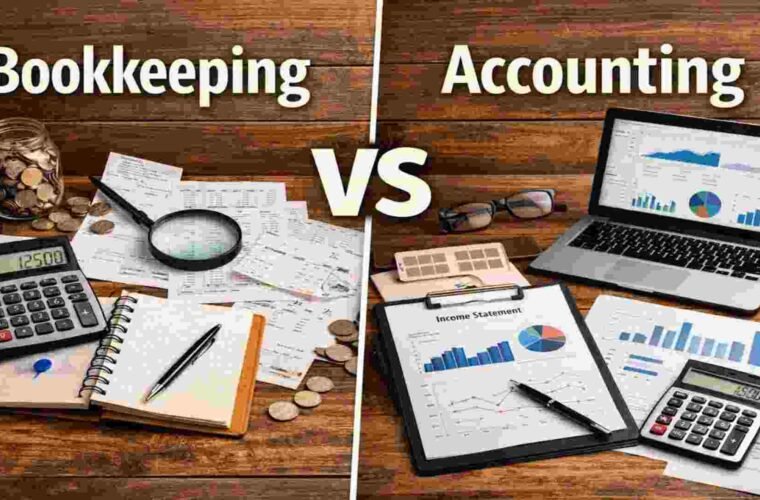
What’s the difference between bookkeeping and accounting? Bookkeeping is recording daily transactions; accounting involves analyzing, interpreting, and reporting on those records for decision-making. [link to related guide about bookkeeping vs accounting here]
Do I need to understand all basic accounting terms if I hire a CA? It genuinely helps to understand the core terms even with a CA, so you can make informed decisions and catch potential errors.
What accounting software is good for beginners in India? Tally, Zoho Books, and QuickBooks are commonly used by small businesses in India, with varying complexity and pricing.
How often should a small business review its financial statements? Monthly at minimum — waiting until year-end to review finances is a common and costly mistake among small business owners.
What is GST input credit, in simple terms? It’s the tax you paid on business purchases that you can subtract from the tax you owe on your sales, reducing your overall tax liability.
Is cash basis or accrual basis better for a small business? Cash basis is simpler and suits very small businesses; accrual basis gives a more accurate financial picture and is required once your business crosses certain revenue thresholds.
Conclusion
Understanding these basic accounting terms for beginners won’t make you a chartered accountant, but it will make you a far more informed business owner — someone who can actually read their own numbers instead of nodding along blankly. Start by reviewing your own balance sheet and P&L this month with this list next to you, and things will click faster than you expect.